OsteoFast — bone regeneration, told from the peptide side.
Bone is the only organ that rebuilds itself without a scar. Osteoclasts clear the old, osteoblasts lay down the new, and a small set of signalling proteins — the bone morphogenetic proteins — call the builders to the site. This page is Panacea Bio Chem's research record on that biology: what the literature establishes, where osteogenic peptides fit, and which parts of the story are Panacea's own in-house work, labelled as such.

How bone rebuilds itself
Bone looks static and is anything but. Throughout life it is remodelled in a continuous cycle: old or damaged bone is removed and new bone is deposited in its place. Two cell families run the cycle, and the balance between them decides whether the skeleton gains or loses ground.
Osteoclasts — the demolition crew
Osteoclasts are large multinucleated cells that attach to bone and resorb it, secreting acid and collagen-degrading enzymes that dissolve the mineral and digest the matrix. Removal is not destruction for its own sake: it clears micro-damage and opens the space that new bone will fill. Background: osteoclast biology.
Osteoblasts — the builders
Osteoblasts synthesise the collagen-rich bone matrix (osteoid) and drive its mineralisation with hydroxyapatite, turning soft scaffold into hard tissue. Some are buried in the matrix they made and become osteocytes, the skeleton's long-lived sensor network. Background: osteoblast biology.
Remodelling — the lifelong cycle
Resorption and formation are coupled: in a healthy adult skeleton, teams of osteoclasts and osteoblasts work in sequence at millions of remodelling sites, replacing a fraction of the skeleton every year. When formation falls behind resorption, bone mass declines. Background: bone remodelling.
Fracture healing — regeneration in fast-forward
After a fracture the body runs an emergency version of the programme: a hematoma forms, a soft callus bridges the gap, a hard callus mineralises it, and remodelling slowly restores the original shape over months to years — scar-free repair that few other tissues can match. Background: fracture healing stages.
The signals that switch bone on
If the cells are the workforce, the signalling proteins are the foreman. The best-studied of these are the bone morphogenetic proteins — and the reason peptides are interesting to regenerative science is that a short chain of amino acids can carry, or mimic, a foreman's message.
What the literature establishes
- Bone morphogenetic proteins (BMPs) are growth factors of the TGF-β superfamily that induce the formation of bone and cartilage; they were first identified through the observation that demineralised bone matrix triggers new bone growth (Marshall Urist, 1965). Background: bone morphogenetic proteins.
- Recombinant BMP-2 and BMP-7 have received regulatory approval for specific orthopaedic uses such as spinal fusion and certain non-union fractures — an existence case that an externally supplied osteogenic signal can drive local bone formation in humans.
- Teriparatide, a recombinant fragment of parathyroid hormone (PTH 1-34), is an approved anabolic agent for some forms of osteoporosis: intermittent dosing stimulates osteoblasts and new bone formation. It is, in effect, a first-generation osteogenic peptide therapy. Background: teriparatide.
Where the open questions live
- Large protein signals are potent but blunt: dosing, localisation and duration are hard to control, and clinical use of BMPs has been accompanied by documented debates over dosing and off-target effects.
- Smaller peptide motifs — fragments or mimetics of the active regions of BMPs, PTH and related signals — are an active preclinical research direction, aiming for tunable, manufacturable osteogenic signals. Most remain investigational.
- A peptide is only as good as its journey to the bench: short sequences are chemically fragile, and synthesis, drying and storage conditions decide whether the molecule that arrives is the molecule that was designed. That engineering problem is where Panacea Bio Chem's interest sits.

The OsteoFast perspective
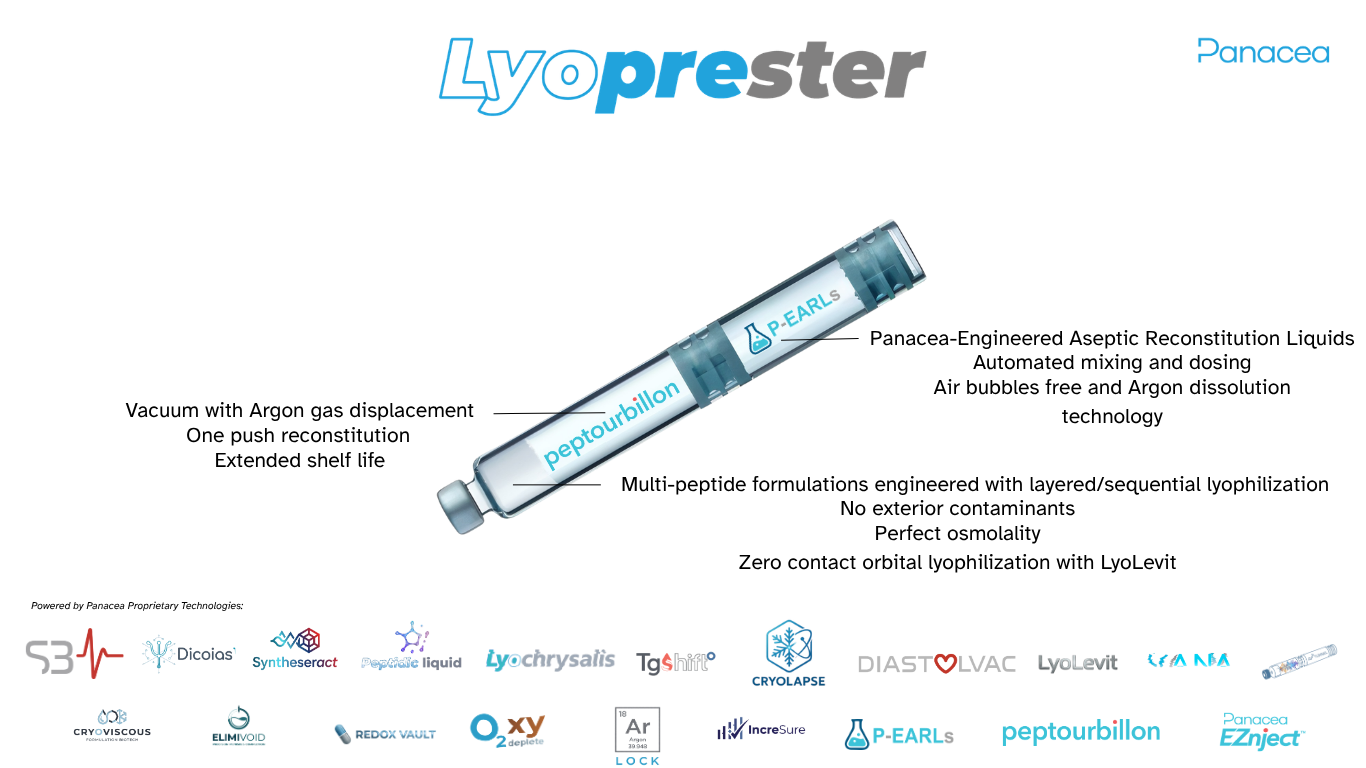
Panacea Bio Chem's OsteoFast line of work approaches bone regeneration from the peptide side: the design, synthesis and preservation of osteogenic peptide candidates — short amino-acid chains intended to engage bone-formation signalling, studied as research materials rather than products. The house's standing competencies — peptide synthesis, low-temperature lyophilisation, and the S3Pulse™ biointegrity monitoring engine that guards molecular integrity through drying and storage — are directed here because osteogenic peptides are exactly the kind of fragile molecule where that last mile decides everything.
The OsteoFast programme is Panacea's forward-looking research position: an in-house programme whose candidate sequences and process parameters are proprietary Panacea intellectual property. The cited external science stands on the public literature and is linked as such; nothing on this page claims a finished therapeutic.
Panacea in-house research programme · forward-looking research position
"Bone already knows how to rebuild itself — the biology is not the mystery. The mystery is why we keep trying to shout at it with sledgehammer proteins when the body's own instructions are written in short, elegant sentences. Peptides are those sentences. Our work is to write them cleanly and keep them intact until they are read."
About the researcher: Bogdan Dicoias — Biochemist · AAC Designer · Panacea Bio Chem Ltd
What this page is, and what it is not
This page mixes two kinds of statement, and it keeps them visibly separate. The background science — remodelling, osteoblasts and osteoclasts, BMPs, teriparatide — comes from the public literature and is linked to its sources. Everything about Panacea Bio Chem's own programme is in-house and proprietary, and is labelled that way rather than dressed up as external fact. Where a claim cannot be externally verified, this page says so in plain words.
Cited and external
The cell biology of remodelling, the BMP story from Urist onward, the approved status of rhBMP-2/rhBMP-7 and teriparatide, and the stages of fracture healing — each linked to a public reference in the text above and on The Story.
In-house and unverified
OsteoFast as a programme, its candidate peptides, its preservation methods and its timelines. These are Panacea Bio Chem's own research directions — disclosed in outline, held in detail, and not presented as established science.
Frequently asked questions
What is OsteoFast?
OsteoFast is Panacea Bio Chem's research record on bone regeneration and osteogenic peptides: a forward-looking perspective on designing, synthesising and preserving peptides that could engage bone-formation signalling. It is a research programme, not a product.
What does bone regeneration actually mean?
Bone is remodelled throughout life: osteoclasts resorb old bone and osteoblasts deposit new bone in its place. Bone regeneration research looks for ways to support that formation side when a defect or fracture is too large for natural healing to bridge.
What are osteogenic peptides?
Short amino-acid sequences designed to engage the signalling pathways that drive bone formation — for example motifs derived from bone morphogenetic proteins. They are an active preclinical research area; most are investigational and none described here is an approved therapy.
Is anything on this page a medical treatment?
No. This page is an educational research perspective by Panacea Bio Chem. The external background science is cited; Panacea's own programme is the house's proprietary in-house research. Nothing here is medical advice.
Trending in the field
Recent developments in the field — refreshed 2026-10-21 by Panacea Bio Chem.
- RSPO2 synergizes with BMP2 to enhance Wnt-dependent bone healing — PubMed, 2026 Oct 20
- Nutritional support in bone infections: mechanisms, strategies, and clinical practice — PubMed, 2026
- Bionic nanocoating-mediated near-infrared persistent luminescence photodynamic system for the treatment of periprosthetic joint infection — PubMed, 2026 Oct 15
- Modified split bone block technique for reconstruction of the atrophic edentulous maxilla: a retrospective clinical study — PubMed, 2026 Oct 17